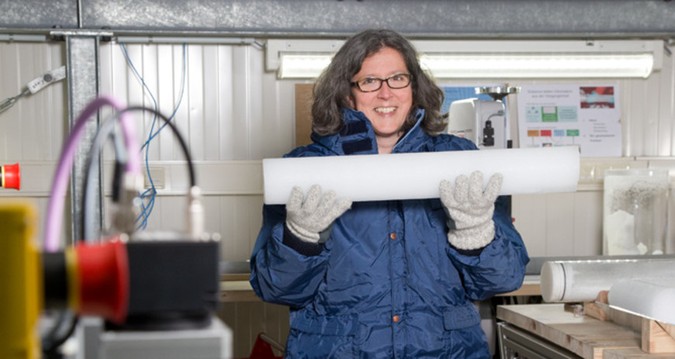
Professor dr. Angelika Humbert is an expert in glaciology and she works at one of the most important institutes for polar and marine research the Alfred Wegener Institute. But first lets see what actually is glaciology. As prof.dr Humbert explains glaciology is investigating the dynamics of glaciers, so basically the physics of glaciers, and aims to understand how glaciers flow, how icebergs are calving, under which conditions glaciers are growing and shrinking.“Our duties are manyfold – we are doing observations, either with satellites or with instruments on aircrafts or on the ground or we take samples to be analysed in the lab and we are doing modelling and work on the theory of the physics of glaciers. You may spend a lot of time with data analysis, with preparations of field surveys or with setting up numerical models, programming and analysing numerical experiments“ says Angelika Humbert at the Alfred Wegener Institute.
Why you choose glaciology?
AH: I came originally from elementary particle physics and during my maternity leave, I read about glacier dynamics, just by chance and got more and more curious about it. As I was always somewhere in between theory and observations in my time in particle physics, I found modelling of ice shelves very attractive. You have to use and analyse a lot of data, while you also have to get into the theory. And I found it even more attractive to model a system that is in connection with the ocean, which ice shelves are. So, that’s how I got into it and up today I can only say, that the excitement has not declined. At that time I started with glaciology I did not yet realise another very cool aspect of it: glaciology is so much relying on other disciplines, that you spend a lot of time with colleagues from other fields and learn about their concepts. That is not always convenient, as each discipline has its own ‘language’ and it takes quite some energy to get into it, but you have a lot of those ‘oh how cool is that’ moments, if you see what other disciplines are doing and what kind of solutions they find.
Ice sheets and glaciers are losing mass worldwide. What are the consequences and what is the solution?
AH: With glaciers loosing mass, sea level rises. It is as simple as that. Without wanting to scare anyone, the ice sheets in Antarctica and Greenland have the capacity to rise sea level by more than 70m. This won’t happen tomorrow and not this century, but sea level rise is even in the range of decimeters an issue for many populations along coastlines. We do have areas in ice sheets, that may become unstable. Unstable means that they might retreat very quickly and if that started, you can’t counteract. An example: if a glaciers rests on a bedrock which is tilted towards the centre of the ice sheet in contrast to be tilted towards the ocean, once a retreat started, the glacier retreats until he gets with his grounding line again onto a position where the ground is tilted towards the ocean. There is a debate among glaciologists if that is currently going on in West Antarctica and this area has the potential to rise sea level by 3.3m. But even without areas getting indeed unstable, glaciers retreat and accelerate in Greenland, leading to a continuously rising sea level. The solution would be, that the ocean gets cooler again, warm water masses would not be able to make their way to glacier fronts and –of course- that the air gets cooler! How you achieve this best is not my expertise, but one thing is absolutely clear, we should not lose any time to act, as glaciers are recovering not quickly.
You had a chance to visit Antarctic and Greenland, can you describe us how it looks like, what do you find the most interesting about it?
AH: White! Once you approach with the aircraft the ice sheets, the most fascinating thing are the massive crevasse zones of the glaciers and icebergs. This is incredible. I can’t take my eyes off the windows then. More inland you often don’t have much to see than shades of white and surface structures that look like dunes of snow. What is really an extreme experience is the so called white outs. You just don’t see the ground you are standing on, as the sky is white, you don’t see any horizon, it is like you are in a mysterious white that is in a way also bright, which makes it difficult to follow your own traces in the snow.
What do you have to say to those people who do not believe in climate change and how serious is damage already? How bad it could be?
AH: I try to spend my energy to explain how the interaction between climate and glaciers work. The reason is, that people who think they need to believe in it, often have a completely different way to see things. I’m a physicist by training, which is an exact science, I never had to believe in something – you propose a theory, you test the theory. Either with mathematical proves or derivations, or with observations. That’s similar with climate change. You can measure it, it is nothing you have to believe. Most often those who are climate skeptics are asking me ‘Where do you want to know it from?’ and I typically answer, that it is measured by instruments. And I also started to explain these people what has happened already and not what we expect to happen in the next decades, because I think that it is important to distinguish between that. Our abilities to project the exact amount of sea level rise due to ice sheet mass loss in the year 2300 are limited, but our observations of what changes have happened already are quite clear.
The most fascinating about our climate and planet? Also in your opinion what is the biggest mystery in glaciology?
AH: The biggest mystery – and challenge – in glaciology is how ice is sliding above the bedrock. It is very important for us to understand this for modelling purposes, but you always and ever have hundredths to thousands of meters of ice above this interface, which makes it basically inaccessible. You need to develop an understanding for a process that you cannot observe and for which you cannot do any lab experiments.
The most fascinating thing for me is, that the dynamics on the large scale is driven by processes on the microscale.
You announced a record decline in the ice sheets of Greenland and the Antarctic almost three years ago. What was the hardest part of the research and what was the biggest challenge?
AH: The biggest challenge was the setting up a processing chain for the satellite data. That has been newly established by my colleague Veit Helm and required not only a precise processing, but also a processing that is fast enough in terms of computing time. We also spent and do still spend a lot of time in comparing different methods for estimating the mass loss from the original signal of the satellite in order to make it a robust method.
You said “It is frequently said that all ice sheets are melting away, but that is false,” can you explain that to us?
AH: I want to distinguish between melting and more ice being discharged into the ocean due to acceleration of glaciers. In Greenland, melting contributes about half of the mass loss and it is indeed such, that in summer, ice melts at the surface parts of this water makes its way to the ocean. In Antarctica you do have mass loss, although the ice surface is much too cold to melt. This is mass loss due to acceleration of glaciers, day by day more ice is transported into the ocean, without any melt at the surface taking place. A glacier might have lost its floating extension that buttresses the glacier and with that the glacier accelerates. In particular climate skeptics often think that all what we say is wrong because it is much to cold to melt any ice aways in Antarctica. That’s why I think it is good to distinguish between the two.
Is it hard to be a woman in science/glaciology and why?
AH: No, it is not hard! It doesn’t really matter if you are a woman or a man in general. During expeditions, you sometimes want your institute to buy clothes for women and you may find yourself being the only one who would want to clean your mug, but beside that I never found a disadvantage of being a woman in glaciology (and those things could be solved ;) ). We always work as teams, and while the boys may be able to lift heavier boxes than I can, I do have more patience to solder electronics. I also find it in modelling and data analysis quite good to have mixed teams, because for sure men and women have different strategies to solve problems, so acting as teams, we are more capable of finding solutions, I think.
Cover image: Photo: Martina Buchholz
Advertisement
Stats
- Recommendations n/a n/a positive of 0 vote(s)
- Views 856
- Comments 0