Scientists have suspected that non-melanoma skin cancer in patients who have received organ transplants can be caused not only by UV radiation, but also by simultaneous infection with specific types of human papillomaviruses (HPV). Now, a vaccine has been used for the first time to protect mice against such skin tumors. The vaccine is even effective in animals with suppressed immune systems and mice that have previously been infected with papillomaviruses.
Nearly everyone gets infected with HPV once in his or her life. Usually a person's immune system can fend off the viruses. Recipients of donor organs, however, have to take drugs to suppress their immune system for a prolonged period of time to prevent their body from rejecting the foreign organ. A national study in Sweden revealed that on the average, 56 percent of all patients who have received an organ transplant develop non-melanoma skin cancer. Ultraviolet radiation is considered to be the main risk factor in this type of skin cancer. Whether a simultaneous infection with papillomaviruses increases the risk of developing a tumor has not yet been scientifically ascertained. “But the link seemed obvious to us,” says Professor Frank Rösl, head of the current study. “Since sunlight contains UV radiation and one cannot completely avoid contact with it, our approach was to develop a vaccination against types of HPV found in the skin.”
The scientists used a unique animal model in their research: the Southern Multimammate Mouse (Mastomys coucha). This species is by nature infected with papillomaviruses that can cause symptoms such as warts and benign tumors in the skin – echoing the behavior of some HPV types in humans. “The viruses are very much alike,” says Dr. Sabrina E. Vinzón, first author of the study. “In both humans and in mice, non-melanoma skin cancer can develop from the tumors. Thus our aim was to develop a vaccine against papillomaviruses in these mice to see whether we could protect the animals from skin tumors.”
The researchers used so-called virus-like particles to immunize the mice against the virus. “These particles consist of the shells of papillomaviruses but lack infectious DNA,” says Dr. Vinzón. Following the vaccination, the mice developed antibodies against the virus shells, which the researchers detected in the animals’ blood. “If the antibodies subsequently come into contact with real viruses, the immune system can fight these invaders,” Vinzón explains.
The outcome of the study is impressive: “None of the vaccinated mice developed a tumor,” reports Rösl. “They failed to do so even when they had been infected with the virus prior to the vaccination, as well as when we used drugs to suppress their immune systems, as is common for organ recipients.” It is not yet foreseeable whether and when a vaccination will be available for humans.
Content: DKFZ press release (modified).
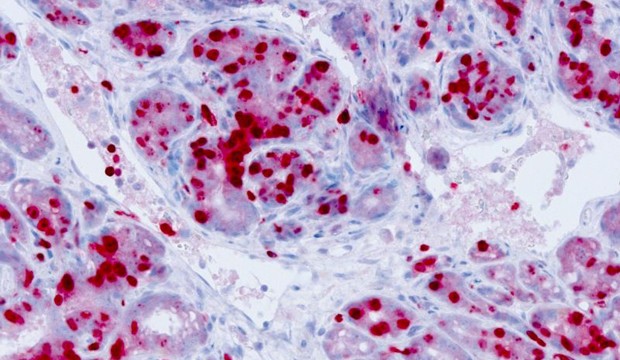
Cover image: Section of a malignant skin tumor in the multimammate mouse Mastomys coucha. Dividing tumor cells are dyed red (Hermann-Josef Gröne, DKFZ).
References
Vinzòn SE, Braspenning-Wesch I, Müller M, Geissler EK, Nindl I, et al. (2014) Protective Vaccination against Papillomavirus-Induced Skin Tumors under Immunocompetent and Immunosuppressive Conditions: A Preclinical Study Using a Natural Outbred Animal Model. PLoS Pathog 10(2): e1003924. DOI: 10.1371/journal.ppat.1003924.
Advertisement
Stats
- Recommendations n/a n/a positive of 0 vote(s)
- Views 2017
- Comments 0