The paper shows that in the years when peregrine migration begins early, the early-migrators appear to cut short their breeding activities, presumably to beat the onrush of raptors. Meanwhile, those species that migrate later do not need to shorten their nesting season. This proves inherent conflict all migratory birds face between trying to produce as many offspring as possible while still maximizing their own survival.
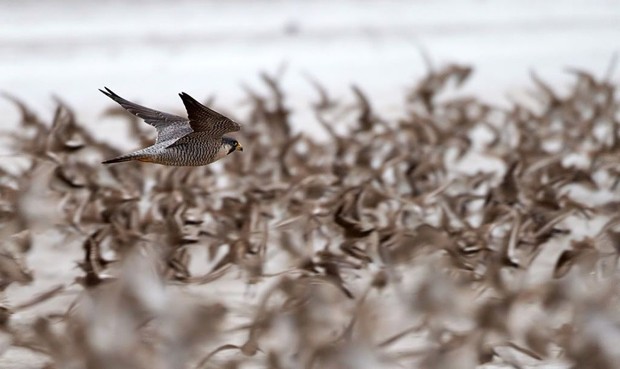
All bird migrations are fraught with danger – from the risk of not finding enough food, to facing stormy weather, and most importantly – trying not to be eaten along the way. Raptors such as peregrine falcons (see picture) are the main predators of migratory birds, and huge flocks of congregating shorebirds can be easy pickings. In a paper, just published in Animal Migration, an open access journal by De Gruyter Open, Dr. Sarah Jamieson and her colleagues provide new evidence that shorebird species can adopt substantially different ways of dealing with this predation pressure.
It turns out that some species simply avoid the periods when peregrines are around, by staying longer at breeding grounds, and migrate only when the coast is clear. Others appear to make a run for it before the peregrines start migrating themselves. And, according to the article – those early-migrating species are capable of timing their breeding activities just spot-on, so that they can leave each year exactly when they need to.
The paper shows that in the years when peregrine migration begins early, the early-migrators appear to cut short their breeding activities, presumably to beat the onrush of raptors. Meanwhile, those species that migrate later do not need to shorten their nesting season. “This paper emphasizes the inherent conflict all migratory birds face between trying to produce as many offspring as possible while still maximizing their own survival” says Andy Davis, Editor-in-Chief of the journal.
According to Dr. Wesley Hochatchka, Assistant Director of Bird Population Studies at the Cornell Lab of Ornithology, “the behavior of one shorebird species, the Western Sandpiper, might appear counter-intuitive at first: why would parents end their care of offspring earlier in a year when weather was allowing for especially prolonged breeding season? This paper shows a complex decision process in which adult sandpipers are attempting to minimize their own risk of predation on migration, even if it means potentially limiting the amount of care to their own offspring.”
The original article is available fully open access to read, download and share on De Gruyter Online.
Cover image: Peregrine hunting, Animal Migration (De Gruyter Open).
Advertisement
Stats
- Recommendations +1 100% positive of 1 vote(s)
- Views 3523
- Comments 0

Recommended
-

Alen Piljić
Managing director | Life Science Network gGmbH
Also:
- President | Research Elements Association