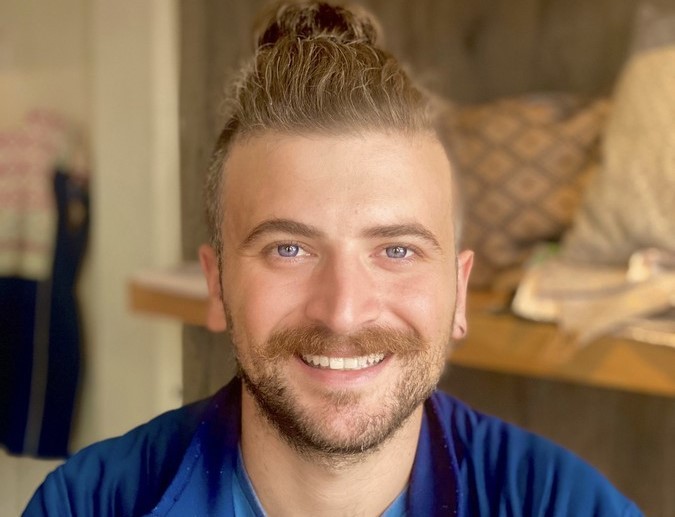
Kaan Mika is a postdoc researcher studying the memory of mosquitoes at ETH in Zurich. He is interested in how mosquitoes remember our smell so they can come and bite again, or, at a molecular level, how their brain is functioning and how their memory is formed. Kaan is originally from Turkey. He is passionate about insects and priorly worked with fruit flies. He is also involved in science communication and is a talented photographer. Positive feedback from his followers makes him want to write and share more about science in a unique way.
What did you want to do after your Ph.D.?
Ph.D. was a hard process. It took me a little bit more than five years and the final year was too intense. My work-life balance was not great. So, I wanted to have a gap year, mostly for my psychology. I wanted to calm down, enjoy life, and discover who I am. Traveling was a good way to achieve all these goals. So, I started traveling around and I have been to South America, Central America, Central Asia, some countries in the Middle East, and some countries in the Balkans. During this period, I continued writing science stories for a newspaper in Turkey and also finished my manuscripts for my Ph.D.
How did you end up doing a postdoc?
After I completed my Ph.D., I was very interested in continuing to work with insects but I wanted to work with an insect that has more influence on human health and that was not a model organism. So, last year, when I was reading different papers and summarizing them in a fun way for the public, I found one paper from my current lab and I was very amazed by this study. So, I contacted the lab and asked if there were any open positions. They had some studies with mosquitoes and malaria-related research. At that moment, in my mind, it was like a puzzle and the pieces got together.
What does your typical week look like? What are your main responsibilities?
When I started working on the project, there were no mosquitoes in the lab. So, I was mainly reading and writing to prepare and establish the experiments of the project. Now, during the week, I set the day by feeding the mosquitoes early in the morning and taking care of them. Actually, mosquitoes follow a cycle. They have different larval stages. They become pupa and then adults. So, you have to adapt your week to their cycle. I also do behavioral experiments with mosquitoes and some molecular biology experiments. So, every week is different from the other one. Besides taking care of mosquitoes, I also have a Master's student to whom I teach some new techniques, how to write proposals, making figures,… From time to time, I also give some lectures. For the lab community, I also have to do little things such as running the dishwasher.
Why do you think this job fits you?
There is no perfect job in the world but I think this job fits me for a couple of reasons. First, I like to work in a lab where different insect species are used because learning about insects is actually my hobby. The insect entomology collection of Zurich belongs to our laboratory and I have the privilege to have access to this incredible collection, which I believe is a great learning opportunity. The second thing is freedom. Research is difficult but it is flexible. Sometimes, you are expected to do overtime work but no one is checking what time you start and when you finish as long as the work is done. The last thing is that the job is quite international. There are people from all around the world. Even in coffee breaks, I am learning something new from a different culture. I'm seeing things from a different perspective and I'm getting more and more used to living in this international environment.
What is the most exciting thing about your field?
There are so many new things that we learn about mosquitoes. It is also an interesting topic because everyone hates them and tells me how much mosquitoes love them. Most importantly, mosquitoes cause a lot of deadly diseases and have a huge economic and health burden in the world. That is why I feel this field is very important. One exciting thing is the introduction of the CRISPR-Cas9 system in mosquitoes. With this system, it might be possible to develop new control strategies to eradicate mosquitoes that cause diseases.. We already see some successful applications of these methods in the laboratory and I look forward to seeing these new methods being used in the field in the future.
What are your future plans?
I would love to continue in academia and have my own laboratory at a good university. However, the competition in academia is intense, and becoming a tenure-track professor is getting harder every day. So this is somehow forcing scientists to leave academia and go for alternative opportunities. Moreover, I would not see this as a waste of energy or time if I do something completely different in the future. At the moment, science communication and doing actual science are giving me pleasure. But maybe three or four years later something else like maybe photography will give me more satisfaction. I think the best for me is to focus on now and do my best in my position with continuous enthusiasm and development. Even when I'm, like, 60 years old, I can start something else from scratch, because I am aware that we are the change.
Thank you to Kaan for his involvement in science communication and for sharing his passion with such honesty.
If you want to get funny information on wildlife and admire beautiful pictures, go check his instagram account (slice_of_science).
Advertisement
Stats
- Recommendations +1 100% positive of 1 vote(s)
- Views 2006
- Comments 0
Recommended
-
Alix Lemaitre
Main position not set