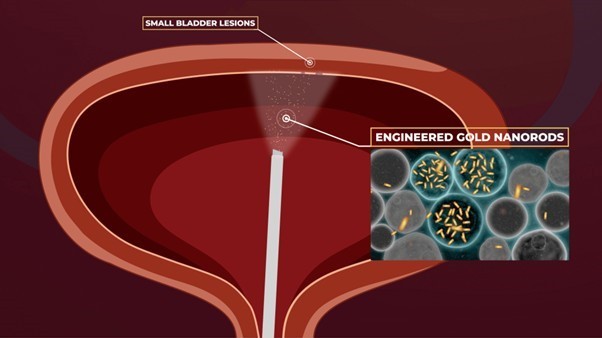
The European-funded PHIRE project, coordinated by San Raffaele Hospital in Milan (Italy), has tested the efficacy and safety of “gold nanorods” to identify and treat, in a single treatment, bladder tumours smaller than 1 millimetre, which have previously been invisible and responsible for relapses.
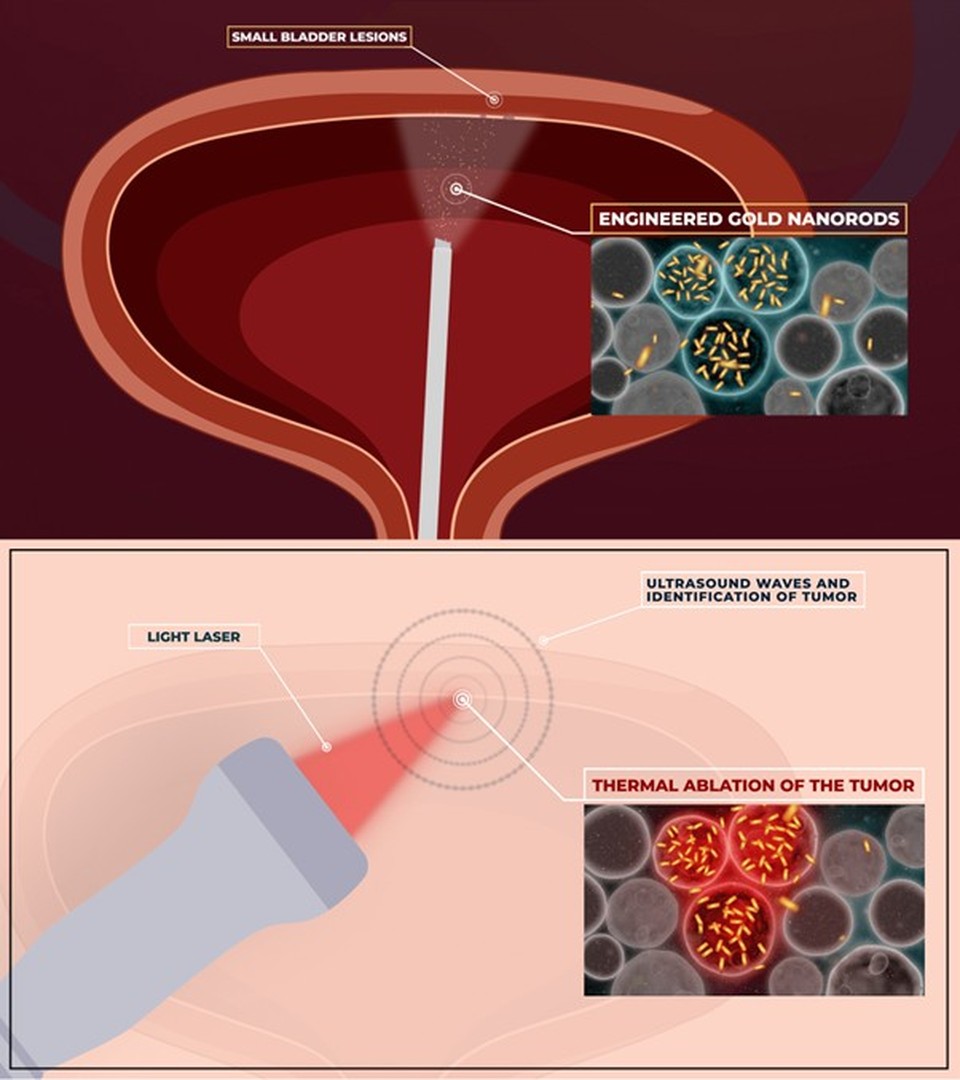 Image 1
 The European-funded PHIRE project, coordinated by San Raffaele Hospital in Milan (Italy), has tested the efficacy and safety of “gold nanorods” to identify and treat, in a single treatment, bladder tumours smaller than 1 millimetre, which have previously been invisible and responsible for relapses.
References
Over half a million new diagnoses of bladder cancer occur each year. This type of cancer is not only the tenth most common in the world but is also one of the most difficult to treat due to therapy resistance and the presence of so-called “residual disease.” Current diagnostic imaging techniques are unable to detect tumours smaller than 1 millimetre, especially when they are flat, making them extremely difficult to remove. Each year, due to these diagnostic and therapeutic limitations, approximately 200,000 patients experience a tumour relapse, forcing them to undergo multiple long and painful treatment paths or, in the worst cases, have their bladder removed. These procedures cost the global health system approximately €9.5 billion a year.
The use of gold nanorods
The PHIRE group of researchers’ latest results led to the publication of the study “Gold nanorods-assisted theranostic solution for non-visible residual disease in bladder cancer” in the Proceedings of the National Academy of Sciences (PNAS) journal. The research demonstrates the efficacy and safety, in preclinical models, of using gold nanoparticles to diagnose and treat bladder tumours smaller than 1 millimetre, promising to minimise “residual disease” and eliminate the problem of therapy resistance.
Researchers have identified and developed a solution to identify and treat bladder tumours smaller than 1 millimetre: these are “gold nanorods,” real gold ingots a few nanometres long. Once infused into the bladder of mouse models through the urethra, thanks to a specific marker, these nanorods recognise and bind only to tumour cells. Through the use of pulsed light, the gold nanoparticles emit ultrasound, making the presence of the small tumour visible through ultrasound. It has also been demonstrated that, if instead of pulsed light, the “gold nanorods” are subjected to continuous light of the same wavelength, they heat up, managing to burn and permanently eliminate small tumours that were previously invisible and ineliminable.
Massimo Alfano, project coordinator of PHIRE and group leader of the Extracellular Microenvironment Unit of the Urological Research Institute - URI, directed by Professor Andrea Salonia, and of the Urology Unit, directed by Professor Francesco Montorsi, of the IRCCS Ospedale San Raffaele, explains that “We have managed to develop a unique solution for the problems that this form of neoplasia entails. In the clinic, it is called the theragnostic approach: thanks to the ‘gold nanorods’ we are able to combine diagnosis and therapy in a single process. Furthermore, since the particles are instilled directly into the bladder and since gold is a biocompatible material, there is no risk of side effects in the surrounding non-neoplastic tissues or organs, effects that a pharmacological or immunotherapeutic therapy could not guarantee. The clinical application of this solution, whose feasibility has been demonstrated in the preclinical model, could reduce the frequency of bladder cancer relapses and the number of patients with recurrent tumours. We expect a great positive impact on the quality of life of patients together with a reduction in social health costs.”
Future perspectives
PHIRE's objective is to bring gold nanorods to the market, for which the IRCCS Ospedale San Raffaele shares the patent with the University of Bologna, for the identification and treatment of bladder tumour lesions smaller than 1 millimetre.
“Our research and development project, of which this study presents excellent results, is now looking for industrial and/or financial partners to see this new technology realised and applied, which, we are sure, will be able to make a difference and guarantee the well-being of many patients,” continues Dr. Alfano. The PHIRE project is thus pursuing its translational mission, that is, transforming the most promising research results into tangible treatments for patients.
“The revolutionary potential of this innovative technology could change the treatment guidelines for bladder cancer. We are confident that the solution identified for residual disease in bladder cancer can also be applied to other forms of neoplasia. The tumour marker recognised by our gold nanorods is also expressed by ovarian and cervical tumours,” concludes Professor Andrea Salonia.
About PHIRE
Health programs crave for diagnostic imaging and eradication of chemoresistant neoplastic lesions smaller than 1 mm of size.
PHIRE aims at bringing closer to market a novel high-resolution theranostic solution effective in clinical applications and ready for use in human bladder cancer. Both male and female patients should benefit from this.
Starting in September 2023, the PHIRE project will run for 3 years, funded by the Horizon Europe programme, under GA No. 101113193.
Documents for download
Advertisement
Stats
- Recommendations n/a n/a positive of 0 vote(s)
- Views 444
- Comments 0