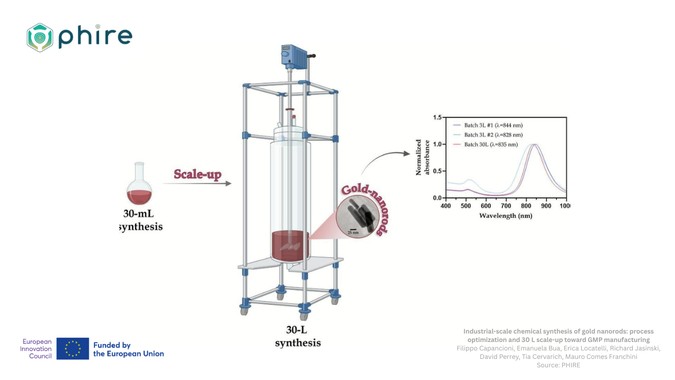
Gold nanorods (GNRs) offer unique photonic properties but remain challenging to reproduce and scale beyond bench volumes. We identify the critical process parameters (CPPs) governing the seed-mediated synthesis of CTAB-stabilized GNRs and translate the process from 30 mL to 30 L. Silver nitrate loading, seed formation (temperature and NaBH4-addition mixing), and growth-phase hydrodynamics emerge as key drivers of the longitudinal LSPR (LLSPR). Tight control of seed temperature and vigorous mixing during reductant addition yield batch-to-batch LLSPR variations within ± 20 nm; introducing gentle agitation during growth suppresses uncontrolled thermal convection, further improving robustness. The optimized protocol produces optically consistent GNRs at 3 L and 30 L with plasmonic features comparable to lab scale. Beyond the experimental advance, this work frames an industrially relevant route to large-scale chemical production of GNRs, establishing process understanding, reproducibility, and quality criteria that underpin future GMP manufacturing design and ongoing regulatory interactions.
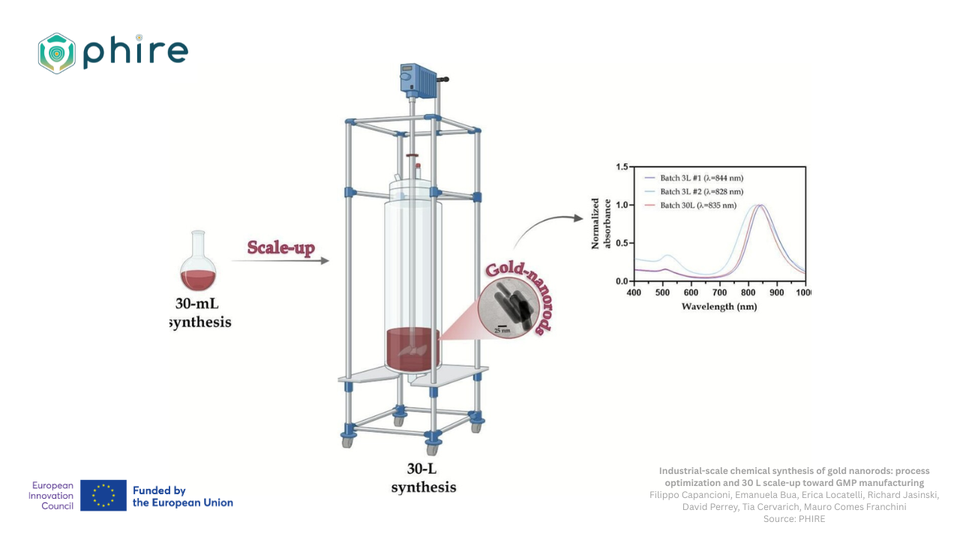 Image 1
 Over the last decade, gold nanorods have gained widespread recognition as one of the most promising nanostructures for various applications. Their attractiveness mainly lies in their unique optical properties, showing a particular NIR-VIS absorption due to the longitudinal localized surface plasmonic resonance (LLSPR) that depends on the aspect ratio (AR, length to width ratio) of the nanoparticles [1]. This parameter can be easily modified by varying reagent concentrations and reaction parameters, thereby obtaining different ARs for the desired purposes. Thanks to their excellent plasmonic properties, numerous GNR applications have been studied, ranging from optics to other disciplines such as biotechnology, chemistry, and medicine [2]. Particularly, large interest has emerged for GNRs use in cancer diagnostics and treatment: a LLSPR centred in the so-called “biological window”, which is the optical wavelengths range in the near-infrared (NIR, 700–1500 nm) characterized by high tissue transparency, allows properly engineered GNRs to be applied for precise visualization of tumour cells and treatment [3], [4], [5]. Photoacoustic imaging (PAI) recently arose as one of the most promising options for cancer diagnostics using GNRs: this technique, based on the conversion of optical energy into a wide-band ultrasound wave originated from GNRs acting as photoabsorbers, generates a rapid thermoelastic expansion of tissues that can be detected with a transducer for precise cancer imaging [6]. At the same time, GNRs photoactivity haa been largely applied in photothermal (PTT) and photodynamic therapy (PDT), exploiting the high photochemical efficiency (PCE) of GNRs in converting NIR radiations into heat, able to cause cancer cells necrosis with low systemic toxicity and invasivity [7], [8], [9].
Starting from pioneeristic studies by El-Sayed [10], Gole [11], and Wang [12], the seed-mediated growth solution method was widely studied and optimized, trying to obtain robust protocols for reproducible nanoparticles synthesis. This method relies on the anisotropic growth of rod-shaped nanoparticles obtained by the selective interaction between cationic surfactant CTAB and AgNO3 onto specific facets of the gold nanoparticles, which causes aggregation onto the uncoated ones: in particular, isotropic gold seeds added to the growth solution undergo symmetry breaking through gold crystal twinning favoured on exposed [111] facet, while higher surface energy of [100] and [110] facets causes CTAB binding and surfactant bilayer formation on them, preventing the growth on these [13]. Moreover, the use of a mild-reducing agent such as the ascorbic acid instead of a stronger agent like NaBH4 in growth solution arrests the tendency of nucleation in growth solution and facilitates the growth of added seeds into anisotropic structures [14].
Many different studies focused on the main parameters regulating the anisotropic growth, like surfactant characteristics [15], pH [16], AgNO3[17], seed solution [14], and ascorbic acid amount [18]. Design of experiment (DOE) has also been applied, underlining the complex interactions between different reaction parameters [19], [20], but the lack of reproducibility in GNRs dimensions and optical absorption is still considered the main issue of the synthesis, limiting their large-scale production and effective application for biomedical purposes. Some studies in literature reported the attempt to scale up GNRs synthesis to larger volumes than lab-scale, but results are still far from pilot-like plants suitable for future industrial productions [21], [22], [23], [24]. Additionally, even if many nanomedicine technologies are nowadays commonly produced in large-scale amounts [25], gold nanoparticle synthesis in the biomedical field is still mainly made by top-down approaches like microwaves, UV irradiation, and other physical methods [26]. The principal drawback of these processes, besides the higher energetic costs, is the lack of dimensional fine tuning allowed by chemical methods, well assessed at lab scale but still difficult to apply at larger scales [27].
In this context, the development of a reproducible and scalable chemical route for the synthesis of gold nanorods represents a key step toward their industrial translation. Although many reports have optimized laboratory-scale syntheses, few have addressed the engineering challenges that emerge when volumes and mass transfer dynamics are extended beyond bench scale. Large-scale nanomaterial production requires the definition of critical process parameters (CPPs) and critical quality attributes (CQAs) ensuring dimensional control, optical consistency, and batch-to-batch reproducibility. The ability to scale up complex colloidal systems such as CTAB-stabilized gold nanorods without compromising their longitudinal plasmonic response is particularly demanding due to nonlinear effects in nucleation, seed growth, and mixing regimes [28].
Therefore, this study not only aims to optimize the physicochemical synthesis parameters, but also to provide a robust industrial-grade process, understanding the bridges that laboratory chemistry and future Good Manufacturing Practice (GMP) design. By identifying and controlling the variables most influencing the longitudinal localized surface plasmon resonance (LLSPR), we establish the technical foundation required for regulatory translation and for future GMP manufacturing strategies.
Filippo Capancioni, Emanuela Bua, Erica Locatelli, Richard Jasinski, David Perrey, Tia Cervarich, Mauro Comes Franchini
Cover image: process optimization of the gold nanorods
References
The PHIRE project is funded by the European Union. Views and opinions expressed are however those of the author(s) only and do not necessarily reflect those of the European Union or EISMEA. Neither the European Union nor the granting authority can be held responsible for them.
Documents for download
Advertisement
Stats
- Recommendations n/a n/a positive of 0 vote(s)
- Views 262
- Comments 0